


When goods are sold or bought Delivery at Place (DAP), it only means the seller delivers the items to a place recently agreed to by the buyer and seller. That can be any location.
The agreed place of delivery should be specifically named, and the buyer should handle the import formalities and transportation to the final destination. It’s quite similar to Delivery at the Terminal (DAT). Let’s learn more about this!
Hide
What is Incoterms?
DAP (Delivered at Place): Definition
Obligations For Sellers and Buyers Under DAP Agreements
Buyers’ Advantages and Disadvantages Under DAP Incoterm
When to Use DAP Incoterm?
What Are the Differences Between DDP and DAP Incoterms?
Conclusion
DAP Incoterms FAQs
What is Incoterms?
Incoterms are standard trade definitions issued by the International Chamber of Commerce (ICC). They’re a set of rules outlining the standard commercial terms utilized in contracts to sell goods. They are intended to divide transaction expenses and tasks between the buyer and the seller.
You will find eleven different standard trading terms with the Incoterms 2020 Rules.
DAP (Delivered at Place): Definition
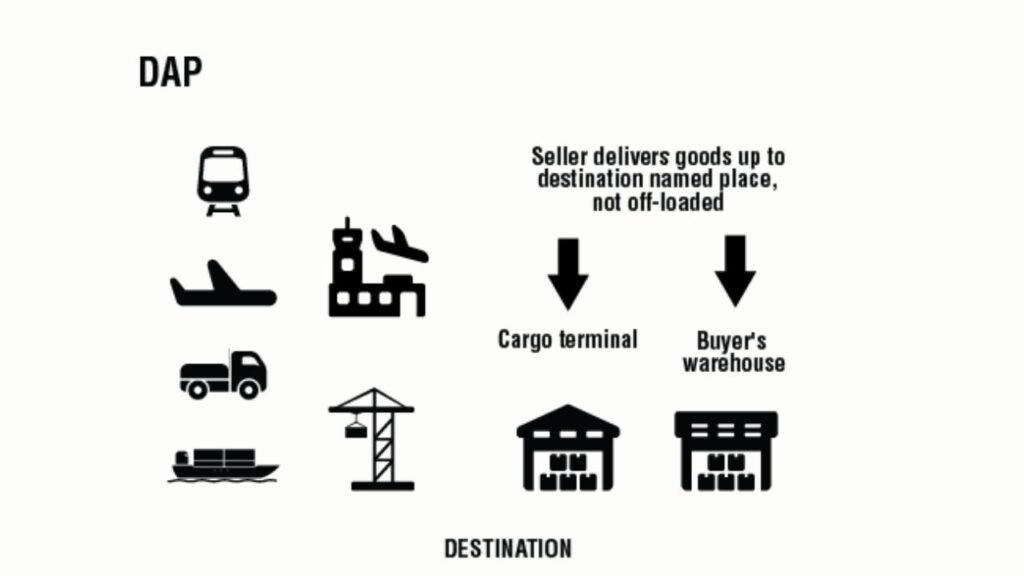
What’s the DAP meaning? Delivered at Place (DAP) means the seller bears responsibility for all risks and costs associated with the delivery of the goods to the last agreed-upon destination, normally the buyer’s warehouse or premises.
Delivered at Place often works for ocean, rail, road, and air freight, and the buyer is responsible for importing and unloading the cargo.
Buyers should understand that Delivered at Place (DAP) doesn’t indicate there will be no extra costs outside of the DAP product cost. The only other fees the buyer should factor in are customs brokerage, import duty and taxes, freight insurance, and any costs incurred to unload the cargo from the container at the destination country.
DAP has since changed the similar Incoterms, DDU, DES, and DAF that were retired in the past decades.
Obligations For Sellers and Buyers Under DAP Agreements

It’s time for us to explore the buyer’s and seller’s responsibilities under the DAP agreement:
Sellers’ obligations under DAP Incoterm
· Export packaging – Prepare the cargo, so it’s ready for export.
· Loading charges – Any costs involved loading the cargo into the truck at the seller’s warehouse.
· Delivery to port or place – The trucking or delivery costs associated with conveying the cargo to the port or place of export.
· Export duty, taxes, and customs clearance – All responsibilities and costs associated with exporting the cargo.
· Origin terminal handling charges – The seller is responsible for such charges.
· Loading on the carriage – The seller must cover other costs to load the cargo into the carriage.
· Freight charges – The shipping costs to transport the cargo to the buyer’s destination country.
· Destination terminal handling charges – The seller is responsible for additional costs.
· Delivery to destination – After the cargo arrives at the buyer’s destination port, you can expect that the seller is accountable for the final journey to truck the load to its last destination.
Buyers’ obligations under DAP Incoterms
· Unload at the destination – The buyer is responsible for the unloading costs once it arrives at their final destination, normally at the warehouse.
· Import duties, taxes, and customs clearance – The buyer is responsible for all the importation costs connected with the shipment. If a customs clearance check is needed, the buyer is also responsible for the check’s cost.
Buyers’ Advantages and Disadvantages Under DAP Incoterm

Advantages:
One of the major benefits for the buyer when using Delivered at Place (DAP) incoterms in their shipping is knowing which party is responsible for paying any extra costs during the entire shipping process. The International Commerce Center indicates the buyer is responsible for all losses and risks associated with the cargo after the items have been made available to them.
In most scenarios, the load would be made accessible to them at the buyer’s warehouse if there are extra costs during the shipping process, the risk transfers to the seller.
Because of that lowered buyer’s risk, DAP provides fewer liability options and a widespread agreement for buyers wanting to put all shipping risk on the seller.
Also, Delivered at Place (DAP) could help the buyer handle cash flow and inventory, particularly costly items that need routine reordering from sellers. Buyers can also negotiate DAP rules when appropriately negotiated with sellers, where the seller fulfills the shipping.
Also, the buyer only needs to pay once the cargo is delivered to their destination.
Disadvantages
· Delivered at Place incoterms could cause snags in the workflow. Normally, customs clearance happens before the cargo finally reaches the customer’s destination. It only means customers should allow the goods to pass before sending them to the buyer. Because of delays and detention, the customer will be responsible for that extra cost.
· To keep the shipping terms sustainable, the seller is fully aware of certain risks. They should take steps to clear all of them, like charging higher costs or increasing deposits.
· DAP can also pose risk transfers for other vendors. It’s when sent to new buyers in these situations. One of the main issues a seller experience is that the buyer may refuse to take the items.
· If the buyer uses a third-party logistics or a freight company, the total cost will be a lot higher.
When to Use DAP Incoterm?
DAP may be a viable option for sellers wanting to consider the options, especially for more experienced importers seeking for a solution to boost cash flow.
Here are some scenarios where a DAP incoterm is a good option:
– If the seller could agree to ship more inventory to the buyer’s premises, normally a bonded warehouse, and the customer can buy the goods from the seller at any time. On top of that, the buyer must pay for the unloading costs and import fees.
– If the agreed place is the buyer’s premises, DAP could indicate the buyer should pay for the freight once the possessions arrive at their location. In this case, the buyer must pay for products on the day they’re received and not type up capital into inventory while being shipped.
– If the buyer is buying products imported into different countries, DAP can provide a good solution that could lessen the freight cost. For instance, if the products were to be purchased from importing countries like China and be shipped to Canada and the US. The cargo could share a single container, delivered to a port close to every country, like Washington or Seattle. The buyer would request the specified place to be a bonded warehouse. Once the cargo arrives at the place, it would be deconsolidated, and part of the consignment imported into the US, and the other part of the delivery transshipped to Canada.
What Are the Differences Between DDP and DAP Incoterms?
Which should you pick, DAP vs. DDP?
DDP (delivered duty paid) is considered a risky term for the seller due to the multifaceted bureaucracy of import clearance procedures, the lack of knowledge about present import duties and rate changes, and the level of risk in hiring customs brokers in destination countries.
If you choose to use DDP, consider that adjustment to mitigate some of the risks that come with hard-to-estimate taxes: DDP.
DDP may also have questionable value to importers, as they should depend on the seller to efficiently navigate such challenges.
DAP is the most preferred option for the exporter who wishes more control over freight but doesn’t like to be involved in import clearance formalities and duties.
Conclusion
Remember that DAP is one of the many incoterms recognized by the International Chamber and is accepted by legal authorities, practitioners, governments, and customs authorities globally for use in international trade.
If you need some shipping services, feel free to contact us today. We will help you deliver your items safely to your designated destination.
DAP Incoterms FAQs
More questions related to DAP rules are answered here!
DAP and DDP, which is better?
DDP is better for first-time consumers and end-consumers. At the same time, DAP safeguards both the seller and buyer equally by ensuring the origin and destination requirements are properly adhered to strictly.
Who pays shipping charges under DAP shipping?
Under the DAP agreement, the seller pays all the freight expenses. The buyer is only accountable for the costs to import the freight and unload the product once it arrives at the requested destination.
What does DAP incoterm mean?
DAP is an incoterm stating that the seller should make the goods accessible to the buyer at the buyer’s chosen location at the origin.
DAP vs. DDP, which is cheaper?
Unlike DDP shipping agreements, DAP rules let the buyer assume more control over their shipping procedures. DAP also grants the buyer the opportunity for cheaper options. The seller often has specific contracted freight forwarders and shipping clients.
Does DAP include clearance?
DAP does include the customs clearance, where the seller performs the export customs. Keep in mind that the import customs clearance is to be performed by the buyer.
DAP incoterm insurance paid by which party?
The seller can recompense for coverage for damage to goods until the selected port and also take marine insurance if the belongings are to be moved by sea.
Dap incoterms, who pay the import duty?
The buyer bears the responsibility for paying the duties, taxes, and customs clearance costs.


 English
  Chinese
  Spanish
  Japanese
  German
  Portuguese
  Arabic